
LaRue County Sex Offender Checks
Begin with the Kentucky State Police Sex Offender Registry. KSP is the controlling statewide source, and its public interface supports both person-based and place-based searches. A name search works best when first and last names are known. Geographic controls help when the question concerns a neighborhood or the county as a whole. Select LaRue in the county field, or use Hodgenville, a street address, or a ZIP code as the interface permits. Upton spans LaRue and Hardin Counties, so an Upton search should not assume that every result belongs to LaRue.
The research did not verify a separate LaRue County public registry map or sheriff list. That makes the KSP registry the first public channel, not a secondary cross-check. The LaRue County Sheriff's Office remains the local registration and reporting contact, while KSP maintains the public website. Save enough identifying details to distinguish people with similar names. A photo, aliases, birth information, physical description, and qualifying offense can help. Address data may change, so report suspected noncompliance through law enforcement and do not confront the listed person.
LaRue Registry Search Routes
A registry result answers a narrow question: whether the public system currently displays a person or location match. It does not replace a court search. If a profile identifies a qualifying conviction, use the LaRue County Court Case Lookup to find the filed case and disposition when those records remain public. A court file may explain the charge language and judgment, while the registry supplies current registration data.
Four access channels cover the practical search path. Search KSP by name or LaRue geography. Use the National Sex Offender Public Website when a person or address may cross state lines. Contact the sheriff or KSP about suspected registration noncompliance. Use any official notification or alert feature the live KSP portal currently offers. Registrants who need instructions about their own duties must follow the sheriff and KSP, not a general website summary.
Kentucky State Police Sex Offender Registry Searches
KRS 17.580 authorizes Kentucky State Police to operate the public registry website. The search is statewide, so LaRue users must apply the right filter instead of treating an unfiltered result list as a county list. Spelling matters in a name search. When exact identity is uncertain, use fewer fields first, then compare the returned profiles. For an area review, start with the county or city and use the map or list view. Do not invent a radius if the live interface does not show one.
Reset the form before changing from a person search to a geographic search. Leftover criteria can narrow the result set unintentionally. If no result appears, check spelling, remove optional fields, and widen the place filter. A blank search should be treated as no match under those criteria, not proof that the person has no Kentucky criminal record.
- Open the KSP registry and read its current conditions and warnings.
- Enter a name, or narrow by address, city, ZIP code, or LaRue County.
- Review list or map results and compare identifiers before selecting a person.
- Open the profile and read the offense, address, status, and registration details together.
| Field Label | Type | Required | Notes |
|---|---|---|---|
| Name search | Text fields | No | Use first and last name; spelling affects results. |
| Address/location | Text | No | Search around a location as the live portal supports. |
| City | Text or dropdown | No | Use Hodgenville for a city-focused review. |
| County | Dropdown | No | Select LaRue for a county-wide result set. |
| ZIP code | Text | No | Narrows a geographic search. |
| Map/list display | View control | No | Switches between geographic and result-list presentation. |
LaRue Registry Search Channels
KSP is the authoritative Kentucky portal. NSOPW is a federal search layer that brings participating jurisdiction data together, then points users back to the source jurisdiction. For a person known to live in LaRue County, KSP is the direct route. For someone who recently moved, works across state lines, or has uncertain residence, NSOPW can widen the search without pretending that one county portal contains the entire record.
The official NSOPW search interface illustrates the national route:
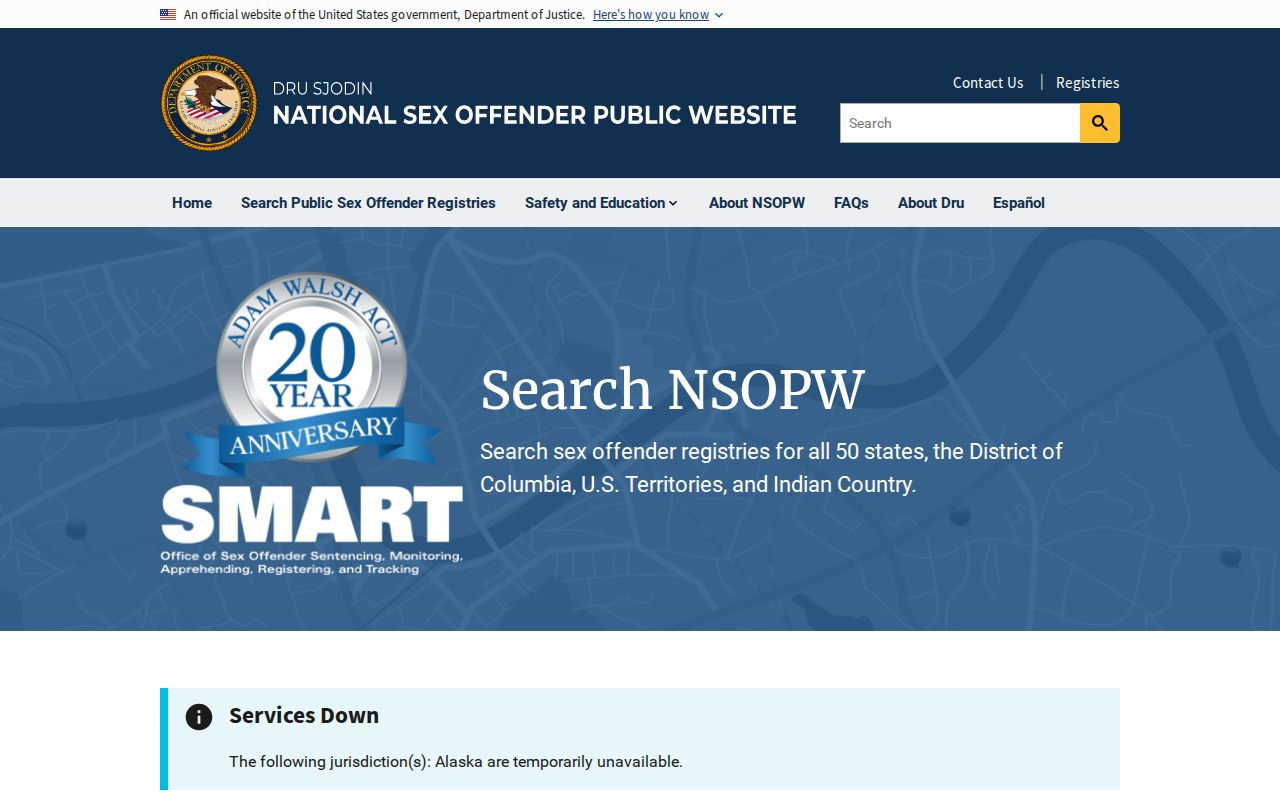
Use a national match as a lead, then open the linked state profile and confirm current details there. Neither portal establishes every criminal case in a person's history.
Registry Profiles: What They Show
A public profile groups identity, location, qualifying offense, and registration information. Read the fields as a unit. A common name alone is weak identification. A matching photograph, alias, physical description, and birth detail make the match stronger. Offense data identifies the conviction linked to registration, but it does not summarize dismissed charges, unrelated convictions, or every court event. Registration status is also different from custody status.
Vehicle information, scars, marks, tattoos, supervising information, and verification notices appear only when collected and publicly authorized. Fields can therefore vary between profiles. Copy the displayed offense and jurisdiction accurately before looking for a court file. Never infer an omitted fact from a blank field or assume that a victim-age category supplies details the public system does not show.
| Name & Aliases | Registrant name plus alternate names shown by the public system. |
|---|---|
| Photo & Physical Description | Current supplied photo and sex, race, height, weight, hair, eyes, scars, marks, or tattoos where authorized. |
| Registered Address | Address and county according to statute and system policy. |
| Offense & Jurisdiction | Qualifying offense, jurisdiction, conviction date, and victim-age category where displayed. |
| Duration | Registration start, end, or lifetime status when applicable. |
| Registration Status | Status, compliance notices, vehicles, and registration or supervising agency when shown. |
LaRue Registry and Custody Records
A registry profile does not say that a person is currently jailed. It also does not function as an arrest history. For Kentucky custody and supervision information, use KOOL or the relevant detention source. For a federal sentence, the Federal Bureau of Prisons offers a separate locator. The official federal inmate locator shows why custody must be checked in its own system:
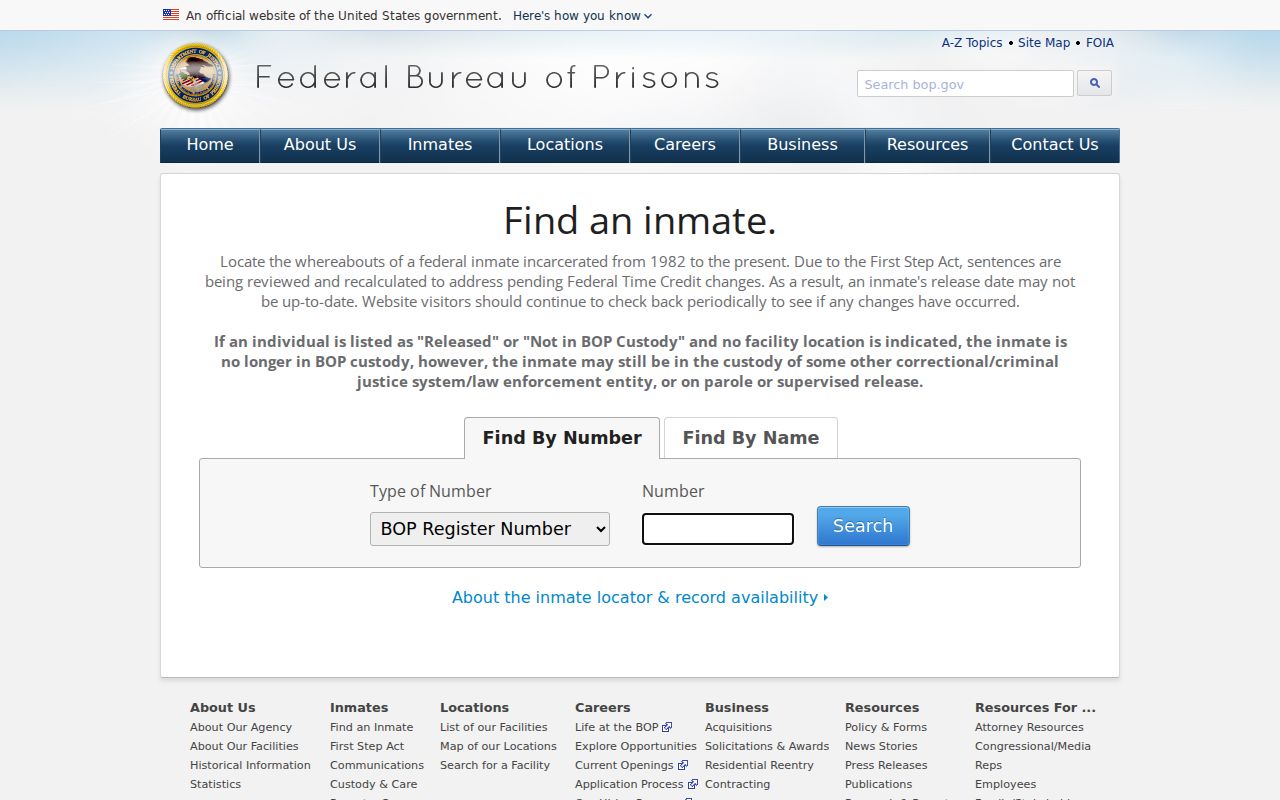
A person may appear in one system and not another because each serves a different legal purpose. Use the LaRue County Arrest Search for local booking and custody routes. Absence from the registry is not a criminal-history clearance, while presence does not prove current incarceration or present dangerousness.
Registration Levels and Duties in Kentucky
Kentucky guidance should follow KRS 17.510 through 17.520. The state uses statutory lifetime and 20-year categories. It should not be converted into the generic federal Tier I, II, and III chart sometimes seen online. KRS 17.510 establishes registration duties, and KRS 17.520 controls duration. The statutory start point and a person's qualifying circumstances matter, so a public summary cannot decide an individual's end date.
Registration duties include reporting through the responsible law-enforcement channels as Kentucky law requires. The public profile may show a beginning date, ending date, or lifetime status, but the displayed label should not be recalculated by a searcher. Out-of-state and federal cases can involve both Kentucky rules and obligations from the originating jurisdiction.
| Kentucky Category | Duration | Controlling Rule |
|---|---|---|
| Persons or offenses assigned lifetime registration | Lifetime | KRS 17.520 lifetime provisions |
| Other registrants covered by the non-lifetime provision | 20 years after the statutory start point | KRS 17.520 non-lifetime provision |
| Out-of-state or federal registrants | Depends on Kentucky and originating requirements | KRS 17.510-.520 plus applicable federal or originating law |
LaRue Registry Law Controls
The official KRS Chapter 17 index is the right place to verify current text rather than relying on a bill summary or an out-of-state tier chart:
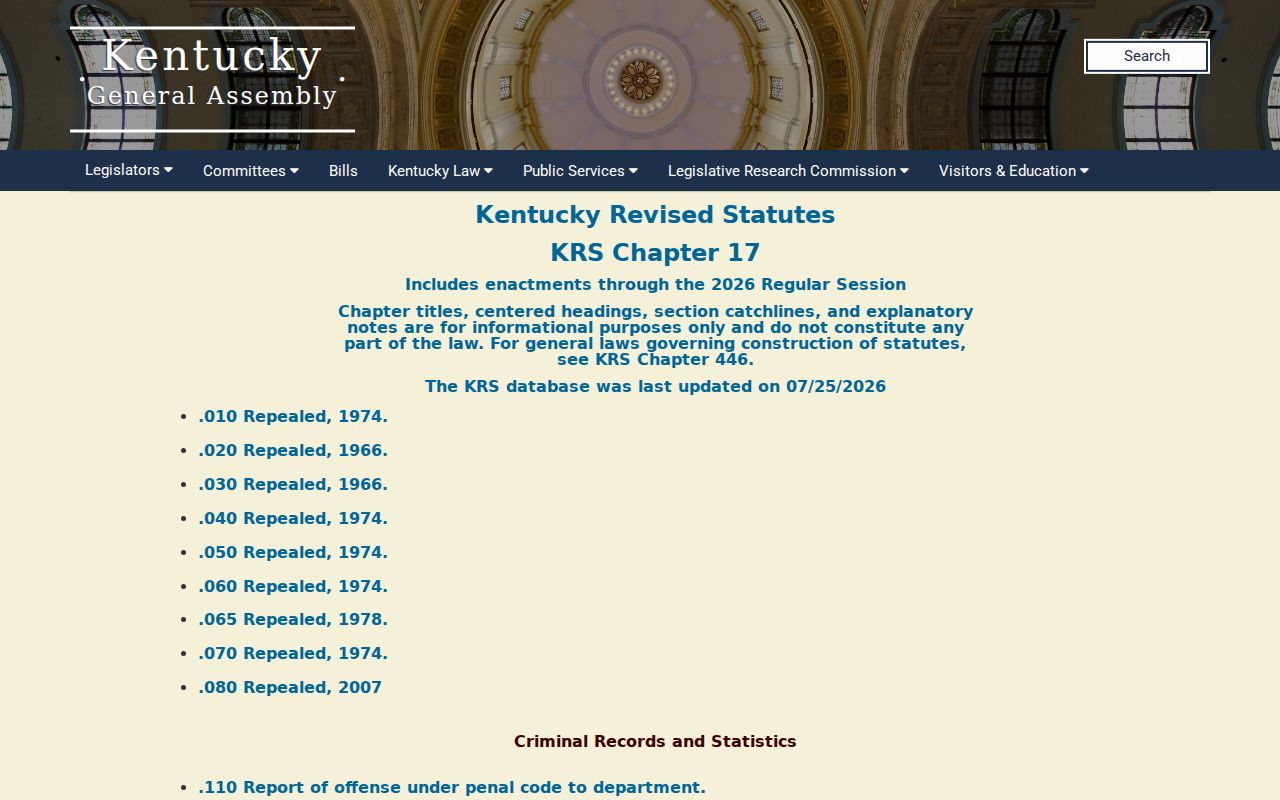
The index connects the public search to the duties and duration rules behind it. Pending legislation does not change a registration period until enacted. When the question is whether a named person must register, when registration ends, or which change must be reported, consult the live statute and the responsible sheriff or KSP office.
Three useful statutory anchors: KRS 17.510 covers registration duties, KRS 17.520 sets the duration framework, and KRS 17.580 authorizes the public website and notification system.
Outdated LaRue Registry Addresses
Do not treat a questionable address as permission to investigate in person. Check the profile's status and identifying fields. Repeat the search with the name and a broader geography, especially around Upton's county line. If the mismatch still appears meaningful, contact the LaRue County Sheriff's Office or Kentucky State Police and describe the suspected noncompliance. Law enforcement can compare information that is not available to a public searcher.
Keep the report factual. Note the profile, the address shown, and the reason it appears outdated. Avoid contacting the registrant, entering private property, publishing accusations, or alerting neighbors as if the discrepancy were proven. Registry entries can lag a lawful update, contain a data issue, or reflect address treatment required by law. The official agency decides whether further verification is warranted.
Using Registry Information Lawfully
The registry supports awareness and reasonable safety planning. It does not authorize private punishment. A profile's presence identifies a statutory registration record, not a current risk assessment. Use official alert or notification features if the KSP portal currently makes them available. For suspected violations, report through the sheriff or KSP. For offense details, verify with the court file. This division keeps a public-safety search from becoming an unsupported accusation.
Misuse is prohibited: KRS 17.580 states that registry information may not be used to harass or intimidate a registrant or the registrant's family. A violation may be prosecuted as a Class B misdemeanor. Do not threaten, trespass, discriminate, or confront someone based on a profile.